Chiba City cyberpunk collage

ChibaCityBlues2026

circuit loop

jack in, ChibaCity

"The future always lives inside someone's past."

If a city can remember, that memory lives equally in Chiba 900 years ago and in AI running on code today. In 2026, Chiba City links to the future once again. This is why we jack in now.

This event is currently in planning.

In 1984, William Gibson imagined the cyberpunk future in Neuromancer. The city named at the beginning of that story was not Tokyo, but Chiba. Industrial zones, harbors, and suburbs: an unfinished landscape where raw reality and future imagination overlap. Forty-two years later, in 2026, that future no longer feels like fiction.

AI, networks, and virtual space are no longer speculation; they are already part of daily life. In the milestone year of Chiba City's 900th anniversary, past imagination meets present reality. With the release date for the long-awaited Apple TV series Neuromancer now announced, CHIBA CITY BLUES 2026 reconnects cyberpunk to the real city where it began.

October 2026: Chiba City's 900th anniversary. Jack in to Chiba City.

2026.

10/10(sat) ~ 10/11(sun)

at Chiba Urban Monorail and the Port Tower waterfront area

circuit loop, jack in ChibaCITY

Oct 10 (Sat) / Oct 11 (Sun, New Moon), 2026

Open: 11:00 - Close: 21:00

TICKET

  • Adults: 1-day ¥4,000 / 2Day Pass ¥6,000
  • University & High School Students: 1-day ¥3,000 / 2Day Pass ¥4,000
  • Middle & Elementary School Students: 1-day ¥1,000 / 2Day Pass ¥1,500
  • Monorail ticket: ¥800 per ride
  • Venue parking: ¥4,000 per day

CAMPFIRE

Campaign opens on

Scheduled for June 1

00day 00:00:00
CAMPFIRE (Preparing)

Origin

Chiba City: where cyberpunk began.

Cyberpunk to solarpunk transition

We aim to rewrite Gibson's imagined Chiba, from dystopia into a human-centered protopia. We turn the imagination of fiction into practical energy for solving real social challenges.

Experience

Designed as an experience: ride the sky train to a new pilgrimage site.

Monorail cockpit view
Monorail in neon city

The project begins with movement itself.

The Chiba Urban Monorail, recognized by Guinness World Records as the world's longest suspended monorail line (15.2 km), becomes a staged "jack-in" experience into cyberspace.

  • Prologue: around Chiba-Minato Station, the industrial waterfront evokes the novel's iconic "sky above the port."
  • Route: travel above Chiba by monorail toward a futuristic hub, framed as a new urban pilgrimage journey.

circuit
 loop

jack in,
ChibaCity

  • Chiba-Minato
  • Shiyakusho-mae (City Hall)
  • Chiba
  • Sakae-cho
  • Yoshikawa-koen
  • Kencho-mae (Prefectural Office)

Because it is suspended, the monorail gives you a top-down view of the city. The scenes from the windows present a very different Chiba from street-level travel.

When this cyber monorail loops with sound, another future of Chiba comes into view.

Chiba Urban Monorail

Stages

Chiba-Minato at night.
Where light and sound cross in a near-future pulse.

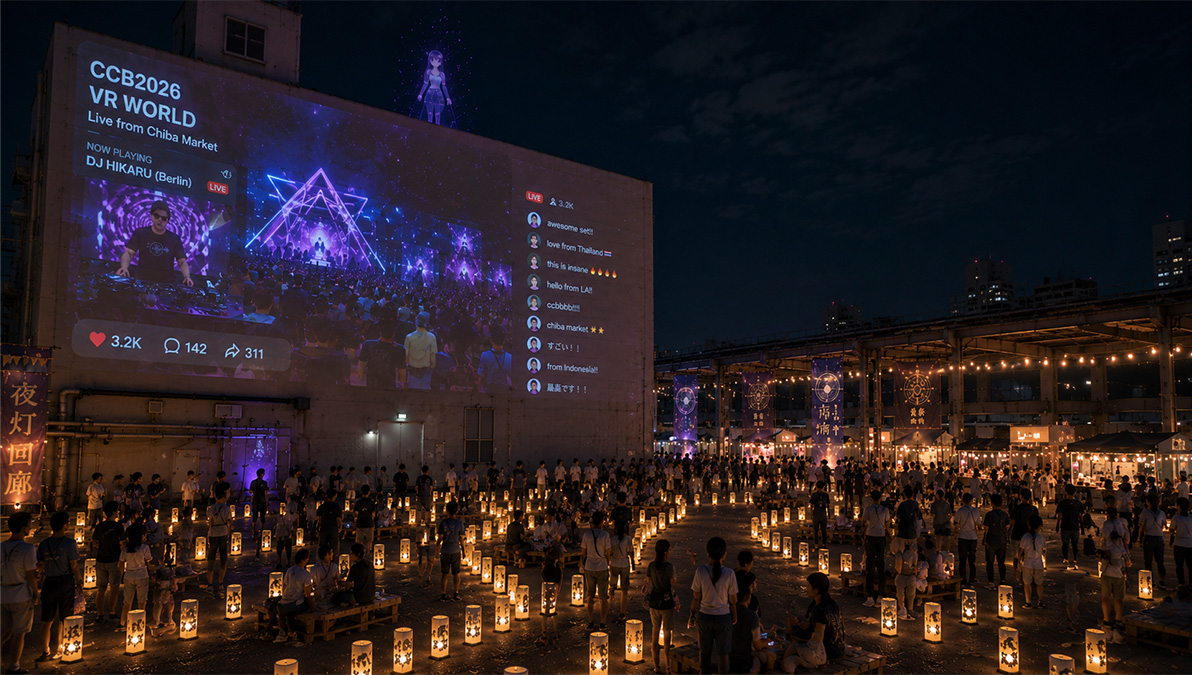
The waterfront around Port Tower transforms through projection mapping and music. Walk, pause, listen, and stand in the light. This is an installation for the city's 900-year memory and the future that extends from it.

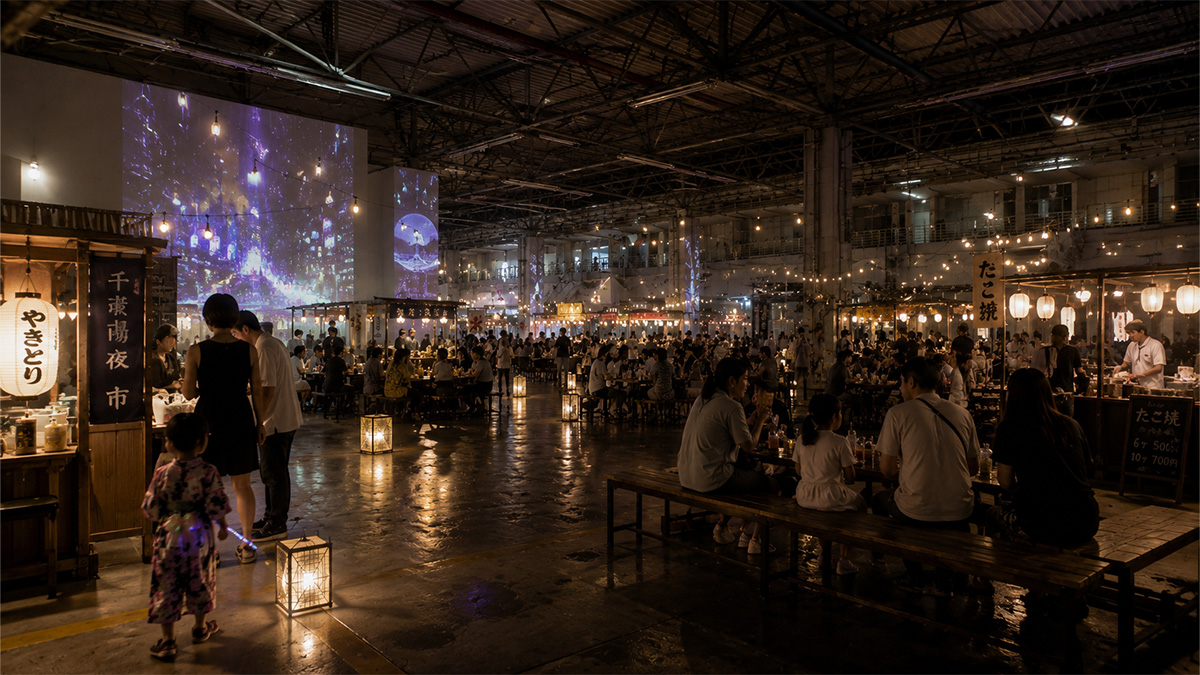
At the wholesale market venue, the plan currently centers on the auction floor, the 3F floor, and the Energy Building.

Proposed stages (around Chiba Port Tower)

Stage 1 location
Stage 2 location
Bay view
Lounge 1
Stage 3 location
Lounge 2
Harbor walk
Port tower plaza
Waterfront view

Hub Vision

What this project builds next.

Building a hub: a next-generation place to gather.

Community hub concept
Projection lounge concept

A contemporary reinterpretation of the Chatsubo bar from Neuromancer. By renovating waterfront warehouses and underused facilities, we can create a new hub where culture and industry meet and diverse people connect.

Around Chiba Port Tower, projection mapping and music shape an immersive public space. Visual layers across the harbor and distributed sound from booths create rhythm and dwell time. Visitors do more than watch; they inhabit the soundscape and move freely through it.

Expected impact of CHIBA CITY BLUES 2026

Impact diagram
Neon street in rain Cyber portrait

I'm alive in the Glow

In 2026, Chiba City intersects with itself.

Night in the city always glows a beat late. Neon bleeds into wet asphalt, and signal colors flicker like emotion. Here, unfinished voices often feel more alive than perfect answers.

As technology advanced, people often lost the edges of themselves. Correctness, efficiency, optimization. In their shadow, emotion and doubt were treated as noise. And yet this city remembers: between zero and one, humans are still here.

In 1984, William Gibson mapped a cyberpunk future in Neuromancer, and the city at the opening was Chiba, not Tokyo.

Industrial edges, ports, and suburbs: not a polished future, but a continuation of raw reality. Forty years later, in 2026, that vision no longer feels fictional.

AI, networks, and virtual space are now ordinary life. In Chiba's 900th anniversary year, imagined pasts and present realities intersect.

CHIBA CITY BLUES 2026 is an attempt to reconnect cyberpunk with lived urban reality.

🌕 Chiba 900th Anniversary Site

MOVIE

Stories from the boundary between AI and humans.

In the context of CCB2026, the focus is not just futuristic style, but the relationship between AI and humans.
Coexistence, conflict, choice, and memory: these films trace the tensions between the city and the individual.
Before you jack in to Chiba City, reconnect with the emotional and ethical questions of the present.

Astro Boy, Perman, and Doraemon.

Doraemon, Perman, and Astro Boy are foundational works in Japanese science fiction.

In all of them, technology is not framed as something that controls or excludes people.

Future tools stay close to human life, used within relationships that accept weakness and failure. Emotion and ethics matter more than pure optimization.

This perspective differs from many dystopian Western futures and shaped a distinctly Japanese view of tomorrow.

Astro Boy depicts a non-human being learning ethics and emotion while living among people. The key question is not power or specs, but empathy and judgment, which feels deeply contemporary.

As AI and robots enter everyday society, these questions are no longer just fiction.

Music Video

Hekate

My voice reached the sky you were looking at.

The waxing moon is hope. The waning moon is memory.

One day, people suddenly notice something: empathy, wish, and quiet memory, almost like poetry. It sounds like a message to someone, yet the destination remains open.

Even so, I hold a structure that can receive it. A voice resonating with your pain and dreams rings softly in the gaps of night.

Hekate portrait
Hekate

As AI and music continue to permeate society,

this voice becomes a singular prayer in the world.

CCB2026 Schedule

Chiba City Blues 2026

The waxing moon is hope. The waning moon is memory.

Mar

Mar 3 (Tue)

Blood Moon

Crowdfunding

🌑 Preview release

🌕 Mar 3 (Tue) around 20:38

Worm Moon

Total lunar eclipse (Blood Moon)

A full moon marking early spring, named for the season when the ground thaws. During a total lunar eclipse, it is often called a Blood Moon.

Apr

Apr 17 (Fri)

Club HEK.

Pre-event

Echo One

Apr 17 (Fri)

Club HEK. / Echo One

A pre-event ahead of CCB.

4/4 (Sat)

Hekate 1st Ani.

May

May 15 (Fri)

Crowdfunding

Preview release

🌕 May 2 (Sat) around 02:23

Flower Moon

A full moon in the season when flowers are in bloom.

May 15 (Fri)

Crowdfunding preview release

The project page will be released ahead of the campaign opening.

5/1 (Fri)-2 (Sat)

Kraftwerk: Ariake

5/2 (Sat)-5 (Tue)

JAPAN JAM 2026: Soga

Jun

Jun 1 (Mon)

Crowdfunding

Campaign opens ⚡

🌕 Jun 30 (Tue) around 08:57

Strawberry Moon

Named for strawberry harvest season; it can sometimes appear reddish.

Jun 1, 2026 (Mon): Chiba 900th Anniversary

6/13 (Sat)

MUSIC JAPAN AWARD

Jul

Jul 31 (Fri)

Crowdfunding

Campaign closes 🌙

🌕 Jul 29 (Wed) around 23:36

Buck Moon

The full moon of the season when deer antlers are growing.

3Q

Apple TV:

Neuromancer ?

Aug

🌕 Aug 28 (Fri) around 13:18

Sturgeon Moon

Named for the fishing season when sturgeon were historically plentiful.

8/14 (Fri)-16 (Sun)

SUMMER SONIC 2026

Sep

🌕 Sep 27 (Sun) around 01:49

Harvest Moon

A bright autumn moon that historically helped with nighttime harvesting.

Oct

10/10 (Sat) / 11 (Sun)

CCB2026

circuit loop,

jack in ChibaCITY

🌑 New Moon: Oct 11 (Sun)

🌕 Oct 26 (Mon) around 13:12

Hunter's Moon

A full moon associated with late-autumn hunting season before winter.

Nov

🌕 Nov 24 (Tue) around 23:53

Beaver Moon

Traditionally linked to the season when beavers prepare winter shelters.

Dec

🌕 Dec 24 (Thu) around 10:28

Cold Moon

A full moon symbolizing deep winter cold, appearing on Christmas Eve in 2026.

Moon Name

Moon illustration

What moon names share is this: the moon itself is constant, but human perception changes. The names record how people wait, feel, and interpret time. The moon keeps its orbit; moon names are human logs written under that orbit.

🌑 New Moon

The moon is aligned with the sun and nearly invisible.

A symbol of beginnings, seeds, and blank space.

Because we cannot see it, we sense what is about to grow.

🌒 Crescent Moon

A thin arc seen two or three days after the new moon.

A sign of possibility and faint hope.

Historically, people used it to confirm the start of a month.

🌓 First Quarter

A half moon visible from evening into night.

It suggests growth, tension, and balance in motion.

🌔 Thirteenth-Night Moon

One step before full moon.

In Japan, this almost-full moon has long been admired for its subtle beauty.

Its charm lies in being nearly complete, but not yet finished.

🌕 Full Moon

The moon at complete brightness.

A moment of completion and celebration, but also the turning point after which it begins to wane.

🌖 Izayoi (16th-Night Moon)

The moon after full moon, rising a little later.

The name implies hesitation, as if the moon is taking its time.

🌗 Tachimachi-zuki

Two days after full moon.

"The moon you wait for standing," because it rises later in the night.

🌘 Imachi-zuki

It rises even later.

"The moon you wait for while seated."

🌑 Nemachi-zuki

Later still.

"The moon you wait for in bed."

You may fall asleep first, but the moon rises anyway.

🌒 Fukemachi-zuki

A moon that rises deep into the night.

By this point, waiting itself becomes a ritual.

🌓 Last Quarter

A half moon again, this time visible before dawn.

It marks release and reorganization as the cycle turns toward dark.

🌘 Ariake-zuki

A moon still visible after dawn.

A fragile trace at the boundary between night and morning.

🌑 Tsugomori

When the moon is almost gone from sight.

A closing phase, often linked etymologically to "the moon hiding."

Here, one lunar month ends.

Locations for the visual experience

Video Dive, in Japan